
What Does Budget Travel South America 3 Months Actually Cost?
Budget travel South America 3 months is achievable for most people — and the numbers are more encouraging than you might think.
Here’s a quick answer if you’re short on time:
| Traveler Type | Monthly Budget | 3-Month Total |
|---|---|---|
| Shoestring backpacker | $1,000–$1,200 | $3,000–$3,600 |
| Budget flashpacker | $1,200–$1,500 | $3,600–$4,500 |
| Comfortable backpacker | $1,500–$2,000 | $4,500–$6,000 |
Key daily cost ranges by country:
- Bolivia: $20–$35/day
- Ecuador: $30–$40/day
- Peru: $35–$50/day
- Colombia: $35–$50/day
- Brazil: $40–$60/day
- Argentina/Chile: $50–$70/day
Three months is a sweet spot for South America. It’s long enough to cover the big highlights — Machu Picchu, the Uyuni Salt Flats, the Amazon, Patagonia — without burning yourself out trying to see everything.
But here’s the honest truth: costs vary wildly depending on your travel style, your route, and the choices you make on the ground.
A solo traveler doing Bolivia, Ecuador, and Peru will spend far less than someone adding Easter Island, the Galápagos, and Patagonia to the mix. Those iconic extras can eat up a month’s budget in a single week.
This guide is built for the flashpacker — someone who wants real experiences without paying luxury prices. Not rice-and-beans-every-meal misery. Not five-star hotels either. Smart, flexible travel that gets the most out of every dollar.
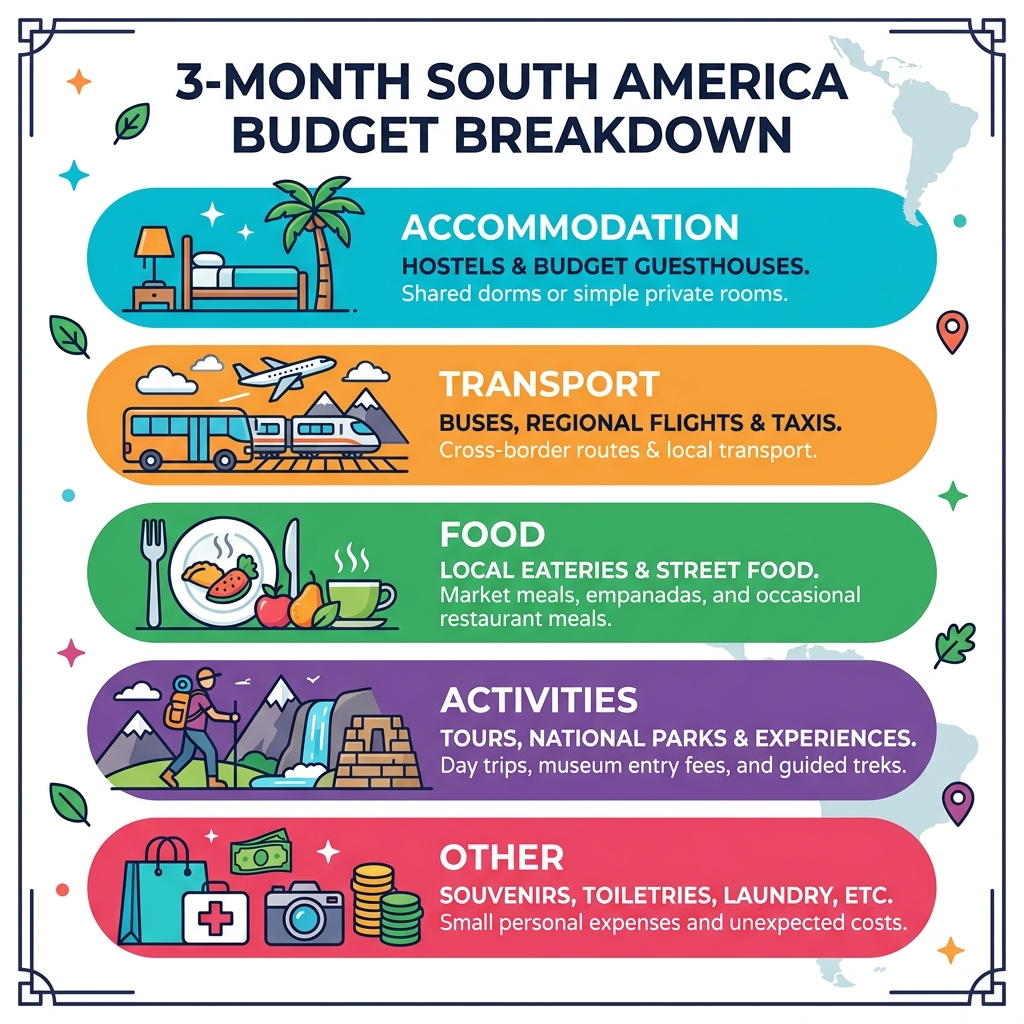
Realistic Costs for Budget Travel South America 3 Months

When we talk about budget travel south america 3 months, we need to be realistic. While stories of $10-a-day travel exist, they often involve extreme sacrifices like sleeping in hammocks or volunteering 30 hours a week. For most of us, a realistic monthly budget falls between $1,200 and $1,500. Over 90 days, this totals roughly $3,600 to $4,500 (or approximately £3,000 to £3,700).
If you are a “flashpacker”—someone who enjoys a mix of dorm beds and the occasional private room, plus high-quality tours—you might find your total closer to £5,000 or £6,000 ($6,500–$7,800). This higher end usually includes big-ticket items like flights to the Galápagos or the classic Inca Trail trek.
To make this work, you need to understand How to Plan a Trip on a Budget. Your daily average is your compass. In cheaper regions, you might spend $30, while in Patagonia, you could easily hit $80.
Daily Cost Comparison Table
| Country | Dorm Bed | Local Meal | Bus (10hr) | Daily Total (Budget) |
|---|---|---|---|---|
| Bolivia | $8–$12 | $3–$5 | $15 | $25–$35 |
| Peru | $10–$15 | $4–$7 | $25 | $35–$50 |
| Colombia | $12–$18 | $5–$8 | $20 | $35–$50 |
| Argentina | $15–$25 | $10–$15 | $40 | $50–$70 |
| Chile | $20–$30 | $12–$20 | $45 | $60–$80 |
Don’t forget that inflation is a moving target in South America. Argentina, in particular, has seen massive price fluctuations. However, for those earning USD, EUR, or GBP, the exchange rates often move in your favor, keeping costs relatively stable in your home currency. For a deeper dive into the basics, check out The Ultimate Budget Travel Guide for New Adventurers.
Cheapest vs Most Expensive Countries
If your goal is to stretch your budget travel south america 3 months as far as possible, your choice of countries is your biggest lever.
- The Budget Champions: Bolivia remains the undisputed king of low-cost travel. You can get a three-course “lunch of the day” for $3 and a clean hostel bed for the price of a coffee in London. Ecuador and Peru follow closely, offering incredible value for world-class sights.
- The Mid-Range: Colombia offers a fantastic balance of modern amenities and affordable prices. Brazil is a mixed bag; while cities like Rio can be pricey, the sheer size of the country means you can find great value in smaller towns.
- The Splurges: Chile and Uruguay are notoriously expensive. Expect European prices for groceries and transport. Argentina is the wild card—it can be expensive, but savvy travelers using the “Blue Dollar” (informal exchange rate) often find it surprisingly affordable.
For 2026, we recommend looking at Best Cheap Countries to Visit in 2026 and Budget-Friendly Cities to Visit in 2026 to spot the latest trends.
Handling Money and Currency Exchange
Managing your money is where you can lose or save hundreds of dollars in fees. We suggest using fee-free digital banks like Wise or Revolut. These allow you to withdraw cash at the interbank rate without the 3% “foreign transaction fee” traditional banks love to charge.
- ATM Tips: ATMs in South America often have high local fees (especially in Chile and Argentina). Try to withdraw the maximum amount allowed to minimize the “per-withdrawal” cost.
- The “Blue Dollar” in Argentina: Always check the current situation. Historically, bringing crisp, high-denomination USD bills to exchange at informal “cuevas” could double your purchasing power compared to using an ATM.
- Cash is King: While cards are becoming more common, you’ll still need cash for market stalls, small hostals, and buses. Keep your USD notes pristine; many exchange houses will reject a bill with even a tiny tear.
For more pro tips, see our Money-Saving Travel Hacks You Need to Know.
Strategic Saving on Logistics and Lifestyle
Logistics—how you sleep and how you move—will be your biggest expenses. But for a flashpacker, these are also the areas where you can find the most “luxe for less.”
Accommodation Hacks
You don’t have to sleep in a 20-person dorm to save money. We often find that for couples or pairs of friends, a private room in a budget guesthouse is the same price as two hostel beds.
- Booking Strategy: Use sites like Hostelworld for reviews, but check Booking.com or Airbnb for “aparthotels” which might offer a kitchen. Having a kitchen is the #1 way to save money.
- Location Matters: Staying slightly outside the main tourist plaza can drop prices by 30%.
- Work the System: Read The Ultimate Guide to Cheap Travel Accommodation and our Budget-Friendly Accommodation Tips for more specific strategies.
Transportation: The Power of the Night Bus
In South America, buses are not the cramped, sweaty vehicles you might imagine. In countries like Argentina, Chile, and Peru, “Cama” or “Semi-Cama” buses feature seats that recline 160–180 degrees, include meals, and sometimes even have a bingo game!
By taking an overnight bus, you save the cost of a night’s accommodation and arrive at your destination ready to explore. It’s a classic budget travel south america 3 months move. Check Low-Cost Transportation Options for a breakdown of when to bus and when to fly.
Sometimes, flying is actually cheaper if you book in advance. Low-cost carriers like JetSmart or Flybondi have revolutionized travel in the Southern Cone. Use Finding Affordable Flights Online to track these deals.
Minimizing Food Costs Without Missing Culture
You haven’t been to South America until you’ve eaten at a local market. Every country has its version of the “Menu del Dia” (Menu of the Day). For $3–$6, you usually get a soup, a main (meat, rice, beans, salad), and a drink. It is the fuel of the budget traveler.
- Street Food: Empanadas in Argentina, Arepas in Colombia, and Salteñas in Bolivia are delicious, filling, and cost about $1.
- Hostel Kitchens: Cooking just one meal a day (usually dinner) can save you $10–$15 daily. Shop at local markets for the freshest, cheapest produce.
- Plant-Based Savings: Meat is a status symbol in many South American cultures and is often the most expensive part of a meal. Opting for beans, lentils, and local grains like quinoa can slash your grocery bill.
- The Alcohol Trap: A few beers every night can quietly destroy your budget. Stick to local spirits (like Pisco or Aguardiente) or buy wine from the supermarket in Chile and Argentina.
If you’re heading to Colombia, read Don’t Bogota Down with High Costs for city-specific food tips.
Extending Your Budget Through Slow Travel
The faster you move, the more you spend. “Slow travel” allows you to negotiate weekly rates at hostels and reduces the frequency of expensive long-haul bus tickets.
If you want to travel for 3 months but only have a 1-month budget, consider volunteering. Platforms like Worldpackers or Workaway connect you with hostels, eco-farms, and schools. You typically work 20 hours a week in exchange for a bed and sometimes meals. It’s a great way to immerse yourself in the culture. Check out Travel on a Shoestring: Hostels That Won’t Break the Bank for places that often host volunteers.
Must-Do Experiences and Itinerary Planning
This is why you’re here. The “Bucket List” items. While these are expensive, they are the soul of your budget travel south america 3 months adventure.
- Inca Trail vs. Salkantay: The classic Inca Trail requires booking 6+ months in advance and costs $700+. The Salkantay Trek is more rugged, can often be booked last minute in Cusco for $250–$350, and offers equally stunning views.
- Uyuni Salt Flats: A 3-day tour from Uyuni (Bolivia) into the Atacama (Chile) is one of the best value-for-money experiences on earth. Expect to pay $150–$200 for transport, food, and basic lodging.
- Galápagos on a Budget: Don’t book a $3,000 cruise. Fly into Santa Cruz, stay in a budget hostel, and take land-based day tours or ferries between islands. You can experience the magic for about $100–$150 a day.
- Amazon Cargo Boats: For a true adventure, take a cargo boat from Yurimaguas to Iquitos in Peru. It takes 3 days, you sleep in a hammock, and it costs less than $50 including food.
Need more ideas? See Discover More for Less: Travel Itinerary Ideas for Budget Trips and our Travel Planning 101: A Comprehensive Guide for Beginners.
A Sample Itinerary for Budget Travel South America 3 Months
How do you piece it all together? Here is a classic “Gringo Trail” route that maximizes your time and budget:
- Month 1: Colombia & Ecuador. Start in Bogotá, head to the coffee region, then Medellín. Cross overland into Ecuador for Otavalo, Quito, and Baños (the adventure capital).
- Month 2: Peru. Spend a full month here. Lima’s food scene, the desert oasis of Huacachina, the white city of Arequipa, and finally Cusco for Machu Picchu.
- Month 3: Bolivia & Northern Chile/Argentina. Cross into Bolivia for Lake Titicaca and La Paz. Do the Salt Flats tour into Chile’s Atacama Desert. Finish with the wine regions of Salta and Mendoza in Argentina, ending in Buenos Aires.
Timing is everything. To save money, avoid the peak summer (January/February) and the July/August holiday rush. The “shoulder seasons”—March to May and September to November—offer the best weather and lower prices. Use A Checklist for Travel Planning: A Beginner’s Guide to stay organized.
Packing for Diverse Climates on a Shoestring
You will face everything from Caribbean humidity to Andean freezes. The key is a layering system.
- Don’t overpack: You can do laundry for $1–$2 per kilo in almost any town.
- Gear: A good waterproof jacket and broken-in hiking boots are essential. Buy your warm alpaca sweaters in Peru or Bolivia for $10 rather than bringing expensive woolens from home.
- Lightweight is Cheap: Avoiding checked bag fees on budget airlines can save you $30 per flight.
Check out our guides: Mastering the Art of Budget Trip Packing, The Budget Traveler’s Guide to Packing Light, and Nailing the Travel Packing Checklist as a Beginner.
Safety, Health, and Insurance Essentials
Is South America safe? Yes, but it requires “street smarts.” Most crime against travelers is opportunistic theft.
Staying Safe During Budget Travel South America 3 Months
- The “No Dar Papaya” Rule: This Colombian phrase means “don’t give papaya”—essentially, don’t make yourself an easy target. Don’t flash your iPhone 15 on a busy street corner.
- Transportation Safety: In big cities like Quito or Bogotá, use Uber or reputable taxi apps rather than hailing cars off the street at night.
- Valuables: Use the hostel locker. Carry a small “dummy” wallet with a bit of cash and an expired card to hand over if you are ever confronted.
- Health: Altitude sickness is real in the Andes. Spend at least 2–3 days acclimatizing in Cusco or La Paz before doing any heavy trekking. Check the CDC travel guidelines for required vaccinations like Yellow Fever.
For more detailed advice, see Travel Safety Tips for Solo Adventurers, Dos and Don’ts: Safety Advice for International Trips, and Backpacker’s Guide: Top Safety Tips.
Navigating Insurance and Medical Costs
Never travel without insurance. A simple broken ankle on a trek can cost thousands in evacuation fees. Ensure your policy covers “Adventure Sports” if you plan on mountain biking the Death Road or trekking over 4,000 meters. Understanding the Importance of Travel Insurance in Budget Trips explains why this is a non-negotiable expense.
Frequently Asked Questions about Budget Travel South America 3 Months
Is $1,000 USD per month realistic for South America?
Yes, but you will be on a “shoestring.” This means staying in large dorms, cooking almost all your meals, and skipping the expensive “bucket list” items like the Galápagos or the classic Inca Trail. It is much easier to achieve this budget in Bolivia and Peru than in Chile or Brazil.
Which South American country is the safest for solo budget travelers?
Uruguay, Chile, and Argentina consistently rank as the safest countries in the region. However, for budget travelers, we find Peru and Ecuador to be very safe as long as you stay in well-traveled areas and follow basic safety precautions.
When is the cheapest time of year to fly to South America?
The shoulder seasons (April–May and September–October) generally offer the lowest flight prices. Avoid late December and January, as this is the local summer holiday season and prices for everything—flights, buses, and hostels—skyrocket.
Conclusion
Planning your budget travel south america 3 months is an exercise in balance. It’s about knowing when to pinch pennies (like eating at local markets and taking night buses) so that you have the funds to splurge on the experiences that will stay with you for a lifetime.
At Larcome Stilo, we believe that the most rewarding trips aren’t the most expensive ones—they are the ones that take you off the beaten path and into the heart of a culture. Whether you are gazing at the stars in the Atacama or sharing a meal with a local family in the Sacred Valley, South America offers a wealth of riches for those willing to look.
Ready to start your adventure? Discover Hidden Budget Travel Gems for 2026 and dive into our Planning Category for more expert guides. Safe travels!
