
Cheap Safaris in Africa Are More Accessible Than You Think
Cheap safaris in Africa are absolutely real — but knowing where to look makes all the difference. Costs range from as little as $365 for a 3-day Masai Mara trip to around $3,250 for a 12-day multi-country adventure. Here’s a quick snapshot of what’s possible on a budget:
| Safari Type | Destination | Starting Cost (per person) |
|---|---|---|
| Short park visit | Masai Mara, Kenya | ~$365 |
| 3-day guided safari | Kruger, South Africa | ~$881 |
| Self-drive camping | Namibia (11 days) | ~$1,675 |
| Overland camping | Botswana (14 days) | ~$2,130 |
| Multi-country wildlife tour | Kenya + Uganda (12 days) | ~$3,250 |
Most people assume an African safari means spending $10,000+. That’s a myth.
The truth? Compromising on luxury doesn’t mean compromising on wildlife. There’s no secret enclosure for animals reserved for high-paying guests. A lion pride looks exactly the same from a budget tented camp as it does from a five-star lodge.
The challenge is that safari pricing is genuinely complex. Park fees, accommodation, transport, and timing all push costs up or down significantly. Countries like South Africa, Namibia, and Zimbabwe offer strong value thanks to favorable exchange rates and solid self-drive infrastructure. Meanwhile, East Africa (Kenya, Tanzania, Uganda) delivers iconic wildlife at a range of price points — from backpacker-style group tours to comfortable mid-range camps.
This guide cuts through the noise. Whether you have $400 or $4,000, there’s a safari that fits.
What to Expect on Cheap Safaris in Africa
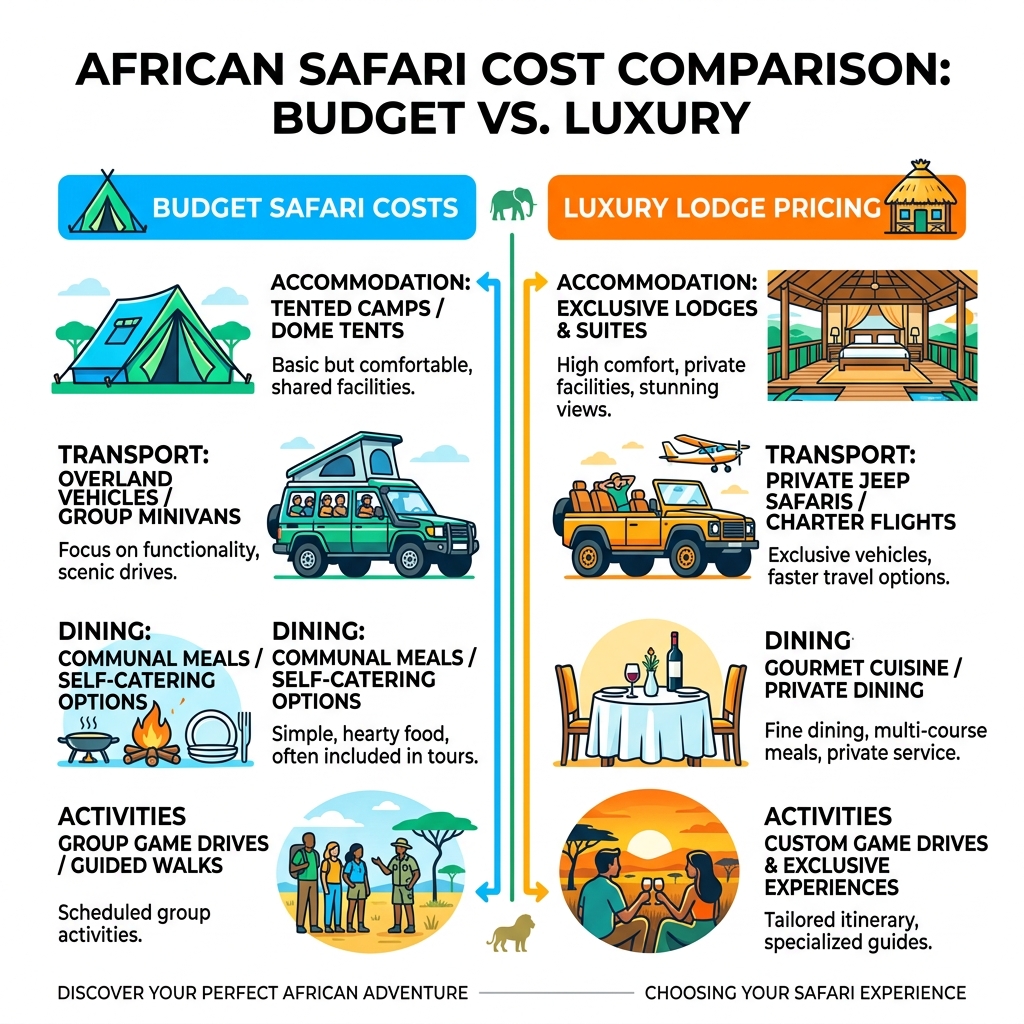
When we talk about cheap safaris in Africa, we aren’t talking about a “lesser” experience. We are talking about a shift in focus. On a budget trip, the “pizzazz” is provided by the Serengeti’s horizons or the roar of a lion near your tent, rather than high-thread-count sheets or private plunge pools.

On a budget safari, you can expect:
- Wildlife Sightings: You will see the Big Five (lion, leopard, elephant, buffalo, and rhino) just as clearly as a luxury traveler. Wildlife doesn’t check your bank balance before showing up at a waterhole.
- Tented Camps and Camping: Many budget options involve staying in “tented camps.” These are often large, walk-in tents with real beds and sometimes en-suite bathrooms. In more rugged “overland” tours, you might help pitch your own dome tent.
- Communal Meals: Instead of private dining, you’ll likely share hearty, home-cooked meals (think “braais” or barbecues, stews, and fresh salads) around a campfire with fellow travelers.
- Bush Showers: While some camps have modern plumbing, others use bucket showers where hot water is hand-poured into a raised tank. It’s surprisingly refreshing!
- Professional Guides: This is one area where quality is never sacrificed. Budget operators still employ expert local guides who know the tracks, the birds, and the behavior of the predators.
If you’re curious about how these accommodations stack up against other low-cost travel stays, check out The Ultimate Guide to Cheap Travel Accommodation for a broader perspective on staying thrifty while exploring.
Realistic Costs for Cheap Safaris in Africa
The price of a safari is a puzzle made of several pieces: park entrance fees, vehicle maintenance, fuel, and labor. A realistic daily budget for a “truly cheap” experience is hard to pin down because a single day-visit to a park might cost $250, while a longer 20-day overland trip might average out to $150 per day.
For 2026, we estimate that a 10-day multi-park trip will cost a minimum of $1,400 per person. If you are looking for a longer, multi-country experience (10–20 days), expect to budget around $2,500. Factors like the exchange rate (especially in South Africa) and seasonal fluctuations play a massive role. To keep your overall travel costs down before you even reach the savanna, read our tips on Experience the World Without Emptying Your Wallet: Budget Hostels.
Inclusions and Exclusions in Budget Packages
One of the biggest traps for first-timers is not checking the “fine print.” Most cheap safaris in Africa include:
- Transportation in 4×4 vehicles or specialized safari trucks.
- Basic camping gear (tents, mattresses).
- Most meals (often full-board).
- At least one or two game drives per day.
However, you will often need to pay extra for:
- Visas: These can range from $30 to over $100 depending on the country.
- Tips: Tipping your guide and camp staff is standard (budget about $10 per person, per day).
- Conservation Fees: Some “low” prices exclude the mandatory daily park entrance fees, which can be $60–$100 per day in places like Tanzania.
- Alcohol and Soda: These are almost always extra.
To save on the journey getting there, we recommend Booking on a Budget: How to Save Money on Flights to ensure your airfare doesn’t eat up your safari fund.
Top Destinations for an Affordable African Adventure
Choosing the right country is the most important decision you’ll make. Some nations are built for high-end fly-in tourism (like Botswana’s Okavango Delta), while others have fantastic infrastructure for budget-conscious explorers.
- South Africa: The king of value. You can pay for park fees in the local currency (Rand), which is often weak against the Dollar or Euro.
- Namibia: Perfect for those who love the “DIY” approach. The roads are well-marked, and the desert scenery is free.
- Kenya: Home to the Masai Mara, where high competition between tour operators keeps prices low.
- Uganda: Often overlooked, Uganda offers some of the most affordable Big Five viewing in Africa, though gorilla permits remain a fixed high cost ($800).
For a specific example of a high-value East African trip, see the 3 Days Masai Mara Budget Safari from Nairobi (2026) – Masai Mara National Reserve.
Value in Southern Africa
Southern Africa is arguably the best region for cheap safaris in Africa because of the “self-drive” culture. In Kruger National Park, you can rent a standard car, stay in a government-run “rest camp” (which are clean, safe, and affordable), and drive yourself through one of the world’s most predator-dense reserves. A 3-day guided Kruger safari from Johannesburg can start around R14,121 ($881 USD) per person, but a self-drive can be even cheaper.
Namibia is another standout. A family self-drive through Etosha and the Sossusvlei dunes can cost as little as €1,675 for 11 days. Even Botswana, known for luxury, has a “back door”: camping safaris. You can find 14-day Botswana camping tours for around $2,130, which is a steal for a country that usually caters to the elite. To understand how to navigate these regions without a private jet, see our guide on Low-Cost Transportation Options.
Affordable East Africa Gems
In East Africa, the “group-joining” safari is the best way to save. By sharing a 4×4 Jeep with 4–6 other people, you split the cost of the driver and fuel. The 3 Days Masai Mara Budget Safari from Nairobi (2026) – Masai Mara National Reserve is a classic example, with prices starting as low as $365 for those willing to stay in budget eco-camps just outside the park gates.
Uganda is our “hidden gem” for 2026. While everyone flocks to the Serengeti, Uganda’s Murchison Falls and Queen Elizabeth National Park offer incredible biodiversity at a fraction of the cost. A 12-day Kenya and Uganda wildlife tour, combining the savannah with primate trekking, typically sits between $3,250 and $3,950 — a massive saving compared to luxury cross-border tours that easily top $7,000.
Best Types of Cheap Safaris in Africa for 2026
Not all “cheap” safaris are built the same. Depending on your comfort level, you can choose from several styles:
- Overland Tours: These are the ultimate “budget” choice. You travel in a large, custom-built truck with a group of 12–24 people. It’s social, adventurous, and covers multiple countries.
- Camping Safaris: Whether it’s “wild camping” in the Okavango (where there are no fences!) or staying in established campsites with showers, this is the most authentic way to hear the bush at night.
- Self-Drive: You rent a 4×4 (often with a tent on the roof) and navigate yourself. This gives you 100% flexibility.
- Single-Park Visits: Instead of a 2-week trek, you spend 3–4 days in one iconic park like the Masai Mara or Kruger.
For those who enjoy the social aspect of hostels, group safaris feel very familiar. You can read more about that vibe in Thrifty Traveler: Affordable Hostels for the Economizing Explorer.
The Benefits of Group Cheap Safaris in Africa
Joining a group is the single best way to slash your costs. When you book a private safari, you are paying for the entire vehicle and the guide’s time yourself. In a group, those costs are divided.
Beyond the savings, group tours offer:
- Social Atmosphere: You’ll meet people from all over the world.
- Guaranteed Window Seats: Most reputable budget operators limit group sizes to ensure everyone can see the lions.
- Expert Handling: Border crossings in Africa can be “adventurous” (read: confusing). Having a professional driver handle the paperwork is a huge relief.
Explore more about shared travel in Low-Cost Transportation Options 2.
Self-Drive and Camping Options
For the truly independent, self-driving is the way to go. In countries like Namibia and South Africa, the infrastructure is excellent. You can rent a fully equipped 4×4 with a rooftop tent, a fridge, and a gas stove.
Campsite rates inside national parks usually range from $10 to $35 per person, per night. Compare that to a lodge that might cost $400 a night! You’ll be responsible for cooking your own meals and navigating, but the sense of freedom is unparalleled. For more tips on managing a DIY itinerary, see Save and See: How to Plan a Trip on a Budget.
Expert Tips for Planning Your Budget Safari
Planning cheap safaris in Africa requires a bit more “homework” than booking a standard beach holiday. Here are our top insider tips:
- Book with Local Operators: International travel agents often add a 20–30% markup. Booking directly with a company based in Nairobi, Arusha, or Cape Town keeps the money in the local economy and your costs down.
- Avoid Internal Flights: Bush planes are expensive and have strict luggage limits. Stick to road transfers. They take longer, but the scenery is part of the adventure!
- Stay Longer in One Park: Every time you move between parks, you pay for transport. Spending 5 days in the Serengeti is often cheaper (and more relaxing) than 2 days in three different parks.
- Pack Soft Luggage: Budget safari vehicles and overland trucks have limited space. Rigid suitcases are a nightmare; use a sturdy duffel bag instead.
For more general advice on stretching your travel dollar, check out these Money-Saving Travel Hacks You Need to Know.
Timing Your Trip for Maximum Savings
Most people want to travel during the “Dry Season” (June to October) because animals gather around waterholes. However, this is also when prices skyrocket.
We recommend the “Green Season” (November to April). While there is a higher chance of rain, the benefits are huge:
- Lower Prices: Lodges and tours often drop their rates by 30–50%.
- Lush Landscapes: The dust is gone, the grass is emerald green, and the photography is stunning.
- Baby Animals: This is calving season, so you’ll see plenty of wobbly-legged zebras and wildebeest.
- Fewer Crowds: You won’t have 20 other Jeeps surrounding one lion.
If you are looking for quality stays during the shoulder season, Quality on a Budget: Low-Cost Hostels Worldwide offers great insights into finding value.
Booking Directly with Local Experts
When booking your safari, look for operators that are SATSA bonded (in Southern Africa) or members of local tourism boards. This provides insurance for your money. Local experts have first-hand knowledge of which camps have the best “budget” vibe and which routes are currently seeing the most wildlife activity.
For more tips on finding these vetted, affordable gems, see Travel on a Shoestring: Hostels That Won’t Break the Bank.
Frequently Asked Questions about Budget Safaris
Which African country is cheapest for a safari?
South Africa is generally the most affordable due to the exchange rate and the ability to self-drive in Kruger. Uganda is also a top contender for affordable guided tours in the savannah.
Is a budget safari safe for solo travelers?
Yes, especially group-joining safaris. You are with a guide and other travelers 24/7, making it one of the safest ways to explore Africa as a solo adventurer.
What is the best time of year for a cheap safari?
The “Green Season” (November to April) is the best time for savings. Avoid the Christmas/New Year peak, and aim for March or April for the best balance of weather and price.
Conclusion
At Larcomestilo, we believe that the world’s most incredible experiences shouldn’t be gated behind a massive price tag. Our mission is to uncover hidden budget travel gems for 2026, and cheap safaris in Africa are at the very top of our list.
By choosing unheralded destinations like Uganda or opting for a self-drive through Namibia, you can witness the majesty of the African wild without emptying your savings. With meticulous planning and a spirit of adventure, your “bucket list” trip is much closer than you think. Start planning your affordable African adventure today and join us in discovering the world, one thrifty mile at a time.
