
The Banana Pancake Trail: Your Quick-Start Guide to Backpacking Southeast Asia
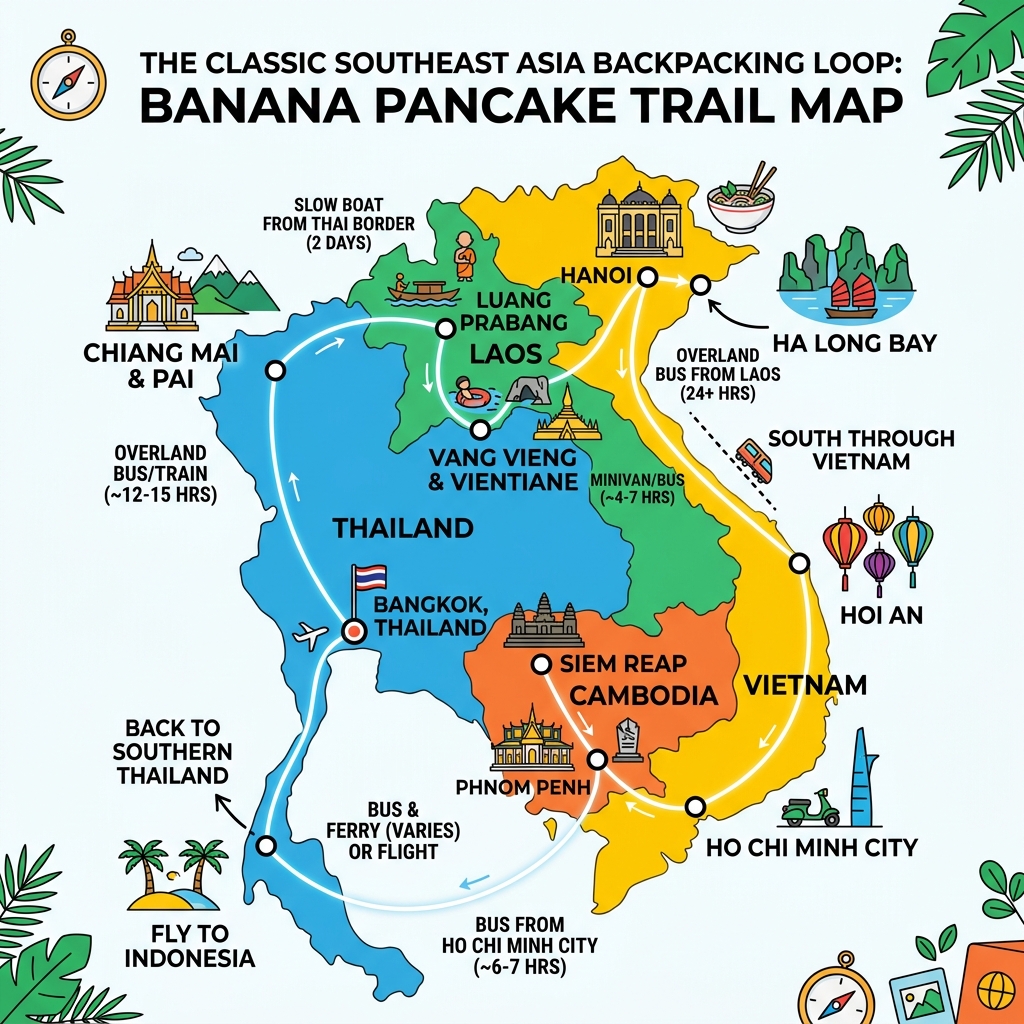
Backpacking Southeast Asia route planning doesn’t have to be overwhelming. Here’s the classic overland loop most backpackers follow:
- Bangkok, Thailand – Start here (cheapest international flights)
- Chiang Mai & Pai, Thailand – Northern temples and mountain scenery
- Luang Prabang, Laos – Slow boat from the Thai border (2 days)
- Vang Vieng & Vientiane, Laos – Caves, lagoons, and river life
- Hanoi, Vietnam – Cross overland from Laos
- South through Vietnam – Ha Long Bay, Hoi An, Ho Chi Minh City
- Siem Reap & Phnom Penh, Cambodia – Angkor Wat and history
- Back to southern Thailand or fly to Indonesia – Islands and beaches
Trip length matters: 1 month covers 1-2 countries well. 3 months handles the full classic loop. 6 months adds Malaysia, Indonesia, Singapore, and hidden gems.
There’s a reason so many travelers describe Southeast Asia as the trip that changed everything. Ancient temples rising out of jungle mist. Street food that costs less than a dollar. Islands so quiet you can hear the coral. And a well-worn backpacker path — nicknamed the Banana Pancake Trail — that connects it all in one logical, budget-friendly overland loop.
But here’s the problem: the trail is more popular than ever. Crowds are growing, prices are creeping up, and the “hidden gems” everyone talks about are getting harder to find without a solid plan.
That’s exactly what this guide is for. Whether you have four weeks or six months, we’ll help you map a route that balances the unmissable classics with the places most backpackers rush past.
Choosing Your Perfect backpacking southeast asia route

Deciding on your backpacking southeast asia route is like standing in front of a giant street food stall: everything looks amazing, but you only have so much room in your stomach (or time on your visa). Before we dive into the “where,” we need to talk about the “how long.”
The biggest mistake we see travelers make is trying to cram five countries into three weeks. You’ll spend more time on rickety buses than actually seeing the sights. Here is how we recommend breaking it down:
- 1 Month: Focus on a “taster” route. A popular choice is the 1 Month Southeast Asia Backpacking Route: Thailand-Laos-Vietnam | Blog . By sticking to the mainland, you avoid wasting days in airports.
- 2 Months: This is the sweet spot for the “Golden Circle” (Thailand, Laos, Vietnam, Cambodia). You can afford to spend a week in places you love without checking your watch.
- 3 Months: The “Standard” long-term trip. This allows for the full mainland loop plus a few weeks of island hopping in Southern Thailand or a quick flight to Bali.
- 6 Months: The “Deep Dive.” Now we’re talking. This is where you add the 17,000 islands of Indonesia, the ancient rainforests of Malaysia, and the rugged beauty of the Philippines.
Before you fly, make sure your health is a priority. Check the Scientific research on travel health for recommended vaccinations like Hepatitis A/B and Typhoid. Trust us, “Delhi Belly” has a Southeast Asian cousin, and you don’t want to meet him.
The Classic 3-Month backpacking southeast asia route
The “Banana Pancake Trail” isn’t a tourist trap; it’s a logical, social, and incredibly efficient way to move through the region. Most travelers start in Bangkok because it offers the cheapest international flights and a “soft landing” into Asian culture.
From Bangkok, we head north to Chiang Mai and Pai. The transition into Laos is a rite of passage: the two-day slow boat from the border at Huay Xai to Luang Prabang. It’s uncomfortable, your butt will hurt, and the “onboard bar” is usually just a cooler of Beer Lao, but the scenery along the Mekong is unforgettable.
After exploring the caves of Vang Vieng, most backpackers take the long (and we mean long — sometimes 24+ hours) bus ride into Hanoi, Vietnam. From there, you follow the coast south to Ho Chi Minh City, cross into Cambodia for the temples of Angkor Wat, and loop back into Thailand. This overland approach isn’t just cheaper; it’s more sustainable and lets you see the transition of landscapes and cultures.
Extended 6-Month Loops and Island Hopping
If you have half a year, the map truly opens up. We recommend heading south from Thailand into Malaysia. Did you know Malaysia is home to some of the world’s oldest rainforests? Taman Negara is estimated to be 130 million years old!
From the mainland, you can hop over to Borneo to see “humans of the forest” (the literal translation of Orangutan in Malay) or fly to Indonesia. Indonesia is a world of its own. While Bali is the famous child, we love the rugged volcanoes of Java and the “blue fire” of Ijen Crater.
Finally, the Philippines offers 7,641 islands (though the count changes with the tide!). It’s harder to navigate than the mainland, but the boat expeditions between El Nido and Coron are often the highlight of a six-month journey.
Country Highlights: From Ancient Temples to Hidden Islands
Every country on your backpacking southeast asia route has a distinct “vibe.” Here is what you can’t miss:
- Thailand: The heavyweight champion. Over 27 million tourists visited in 2023, and for good reason. Between the chaos of Bangkok and the 762 hairpin curves on the road to Pai, Thailand offers everything. Don’t skip the “penis cave” at Railay Beach—it’s a fertility shrine and a great conversation starter.
- Laos: The most “chill” country. Luang Prabang has nearly 80 Buddhist temples and a morning alms-giving ceremony that is truly magical if you remain respectful.
- Cambodia: Home to Angkor Wat, supposedly the largest ancient city in the world at its peak. While the temples are grand, the Killing Fields and S-21 Prison in Phnom Penh are somber, essential visits to understand the resilience of the Cambodian people.
- Vietnam: A land of extremes. From the frenetic motorbikes of Hanoi to the peaceful lanterns of Hoi An. The Ha Giang Loop in the north is arguably the best motorbike ride in the world, but we suggest saving it for the end of your Vietnam leg—everything else might feel a bit dull afterward!
- Malaysia: A cultural melting pot. It’s home to the Sultan Salahuddin Abdul Aziz Mosque, the second-largest mosque in Southeast Asia. We also love the street art in Georgetown, Penang.
- Indonesia: Beyond Bali, make sure to visit Borobudur in Java, the largest Buddhist monument in the world.
- Singapore: Our “soft introduction” to Asia. It’s expensive, clean, and has the best airport in the world. It’s a great place to recharge your batteries (and your bank account) before heading back into the jungle.
Must-Try Street Food and Local Flavors
Munching through street food heaven is a full-time job here. In Vietnam, look for Banh Mi stalls where the bread is crispy and the pate is fresh—it can cost as little as $0.50. In Thailand, Pad Thai is the classic, but try Khao Soi in Chiang Mai for a creamy, spicy noodle hug.
For the brave, the “King of Fruits,” Durian, is a must-try. It smells like old gym socks but tastes like almond custard. Most hostels have a “No Durian” policy, so eat it outside! And of course, wash it all down with a $1 Beer Lao or a fresh coconut while watching the sunset over the Mekong Delta, the largest river delta in the region.
Top Activities and Hidden Gems
While the big sights are great, the “Bottle Cap Moments”—those spontaneous, unscripted memories—often happen in the unheralded destinations Larcome Stilo loves to highlight.
- Scooter Rides: Renting a bike for the Mae Hong Son Loop in Thailand or the Pakse Loop in Laos gives you total freedom. Just remember: those 762 curves are no joke.
- Diving: Koh Tao in Thailand is the world’s factory for scuba certifications. It’s affordable and the community is fantastic. For something more advanced, the Komodo Islands in Indonesia offer world-class drift dives.
- Island Hopping: Gili Air in Indonesia is the perfect middle ground between the party of Gili T and the silence of Gili Meno. You can cycle the whole island in an hour!
| Country | Best Time to Visit | Vibe | Budget Level |
|---|---|---|---|
| Thailand | Nov – Feb | High Energy / Diverse | Moderate |
| Laos | Nov – Jan | Laid back / Nature | Very Cheap |
| Vietnam | Feb – April | Adventure / Food | Cheap |
| Cambodia | Nov – Feb | History / Culture | Cheap |
| Indonesia | April – Oct | Surf / Volcanoes | Moderate |
| Malaysia | March – Sept | Jungle / Foodie | Moderate |
| Singapore | Year-round | Modern / Clean | Expensive |
Planning Logistics, Safety, and Connectivity
A successful backpacking southeast asia route requires a bit of “boring” prep work. First: visas. Most countries offer a Visa-on-Arrival (VOA) or an E-visa. Always check your passport validity—most borders require at least six months remaining, or they’ll send you right back on the next flight.
For transport, we live by 12Go.asia. It’s the gold standard for booking night trains, ferries, and buses across the region. Night transport is a backpacker’s best friend: it saves you the cost of a hostel night and moves you to your next destination while you sleep (mostly).
Logistics for a Seamless backpacking southeast asia route
Crossing borders overland can be an adventure in itself. Places like the Poipet crossing between Thailand and Cambodia are notorious for “stamping fees”—small bribes requested by officials. While we recommend standing your ground, sometimes $2 is worth the lack of a headache.
Stay flexible! We love using Agoda and Hostelworld for bookings, but don’t book your entire trip in advance. You might meet a group of friends in a Bangkok hostel and decide to head to an island you’ve never heard of. That’s the beauty of the trail.
Connectivity is easier than ever. While local SIM cards are cheap, a regional eSIM allows you to cross borders without losing signal. This is crucial for navigating the “dead zones” on the slow boat to Laos or the rural stretches of the Ha Giang Loop.
Safety Tips for Solo and Female Travelers
Is Southeast Asia safe? Generally, yes—often safer than many Western cities. However, common sense is your best weapon. Bag snatching on motorbikes can happen in cities like Ho Chi Minh City or Phnom Penh, so keep your straps secure.
For more detailed advice, check out our backpackers-guide-top-safety-tips/ and the follow-up backpackers-guide-top-safety-tips-2/. Solo female travelers will find a massive community of like-minded women in social hostels. Our top tip? Always have a digital backup of your passport and insurance on a cloud drive. For a deeper dive into staying secure, read our backpacker-guidance-essential-safety-tips/.
Budgeting and Sustainable Travel in 2026
Backpacking used to be dirt cheap, but in 2026, costs are rising. Still, compared to Europe or the US, it’s a steal. An ultra-budget traveler can get by on $30-40 per day in countries like Laos and Vietnam. If you want private rooms and the occasional cocktail, budget closer to $60-70 per day.
To keep costs down, eat where the locals eat. If a stall has a long line of locals and tiny plastic stools, that’s your spot. For more ideas on where your money goes further, see our list of cheap-backpacking-destinations-for-2026/.
Sustainable Practices and Ethical Tourism
As tourism grows, so does our responsibility. We urge you to travel sustainably. This means:
- No Elephant Riding: There is no such thing as an ethical elephant ride. Look for sanctuaries that allow observation only, like BEES in Thailand.
- Zero Plastic: Carry a reusable bottle. Many hostels now offer “Refill My Bottle” stations.
- Reef-Safe Sunscreen: Protect the coral while you’re diving in Koh Tao or the Philippines.
- Cultural Etiquette: Always remove your shoes before entering a home or temple. Cover your shoulders and knees. It’s a small sign of respect that goes a long way.
Essential Packing List for the Region
We’ve all seen that one backpacker struggling with an 80L bag that looks like it contains a small refrigerator. Don’t be that person. Aim for a 40L backpack that fits in a carry-on bin.
- Quick-dry clothes: Humidity is real. Cotton stays wet forever.
- Universal adapter: For those varied plug sockets.
- Power bank: Essential for 20-hour bus rides.
- Mosquito repellent: Malaria is rare on the main trail, but Dengue Fever is not.
- Small padlock: For hostel lockers and securing your bag on night buses.
- First aid kit: Include rehydration salts and charcoal tabs (the “Thai tummy” cure).
Conclusion and Frequently Asked Questions
At Larcome Stilo, we believe the best parts of a backpacking southeast asia route are the ones you didn’t plan for. As we head into 2026, the region is changing, but the spirit of adventure remains. By focusing on unheralded destinations and meticulous planning, you can still find those quiet corners of paradise.
Ready to start your journey? More info about our services can help you find those hidden budget gems before the rest of the world catches on.
Is Southeast Asia safe for solo female travelers?
Absolutely. Countries like Thailand, Vietnam, and Malaysia have very low rates of violent crime against tourists. The biggest risks are petty theft and scams. By staying in social hostels and joining group tours, you’ll never truly be “alone” unless you want to be. Trust your gut and keep your family updated on your location.
What is the best time of year to visit?
The dry season from November to February is the peak for most of the region. The weather is “cool” (which still means 85°F/29°C) and sunny. However, avoid Northern Thailand in March and April—the “burning season” makes the air quality quite poor. If you’re heading to Indonesia, the dry season is the opposite: April to October.
How much does a 3-month trip cost?
For a comfortable 3-month trip covering the classic loop, we recommend a budget of $4,500 to $6,000 USD ($1,500 – $2,000 per month). This includes your flights within the region, activities like diving or trekking, and plenty of delicious street food. Always keep a 15% contingency fund for those “unfortunate but hilarious” moments that require a sudden hotel upgrade or a last-minute flight.
Southeast Asia is calling. The pancakes are warm, the beer is cold, and the route is waiting. See you on the trail!
